
展览名称:陈箴个展——同床异梦
开幕时间:2012年3月24日下午4-6点举行
展览日期:2012年3月24日 – 2012年6月3日
主办单位:林冠艺术基金会 北京
此次的春季展览,林冠艺术基金会将推出中国最知名的先锋艺术代表陈箴的个展。陈箴于1955年在上海出生,2000年不幸去世于巴黎。
与许多同时代的艺术家(如黄永砯、艾未未、徐冰、蔡国强等)一样,陈箴在20世纪80年代晚期离开中国,并迅速以他的混合媒介装置作品吸引了全世界的目光。虽然,陈箴在世界各地都有过展览,但在他有生之年并未在中国举办过个展。此次林冠的展览将呈现陈箴在1992年至2000年之间的雕塑以及装置作品,大部分作品都由各类日常生活用品制作而成,像布匹、蜡烛、椅子、编织品、自行车胎等等。
融超经验
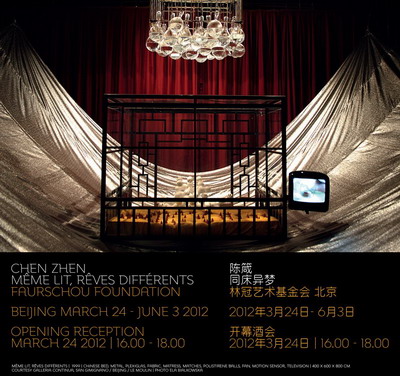
此次展览题为同床异梦,源自展览中的一件大型装置作品,而这个作品诗化般的浓缩了陈箴的艺术。《同床异梦》(1999)是一件复杂的装置作品,作品由一大块织物从天花板悬挂,由一个装有风景画的笼子,一个带有医用玻璃曲颈瓶的网格以及一个电视屏幕构成。这件作品集中体现了陈箴艺术的中心思想: 肉体与精神的和谐统一,不同人种文化之间的博爱与友谊,冲突的解决,中西文化大联谊。
陈箴主要居住于上海和巴黎,经常旅居美国、南美、中东和澳大利亚。在多元文化和全球化尚未被广泛提及时,陈箴已经开始对跨文化社会动力学感兴趣。他个人的跨文化交际经验以及浓厚的兴趣和广泛的文化涉足,令他创造了“融超经验”这个概念。这个理念也是陈箴作品的提炼,同时也表达了他迫切创造异中求同的努力。他的作品更是某种介于中西方思想间的体验,这种体验既是存在的,又是理性的。
物质与精神
在陈箴25岁那年,不幸患上了溶血性贫血症,疾病对他的艺术创作产生了巨大的影响,他的作品经常植入身体的图解,如茧、器官、皮肤、药品和衣料等。受到中医有机整体理念的启发,陈箴探索物质与精神世界之间微妙精细却又不时自相矛盾的联系,探索集团和个体,内在与外在的联系。
《水晶体内风景》(2000),由透明棕色玻璃塑成的内脏器官组成,意在表现中西医学的差异。同时它也揭示了生命的价值和脆弱。几件作品显示不同方式的协同、杀菌和清洁,这些同时也可理解为对我们的环境的协同、杀菌和清洁。
《激动人心的交货》(1999),是一件木偶形式的雕塑。作品由自行车内胎组成,看上去好像要衍生出成百上千的小型黑色玩具汽车。陈箴不少作品都由自行车胎和玩具汽车构成,表达了在中国式进程中,即从自行车时代向汽车时代转变过程中凸显的生态环境问题。
佛学精神和阴阳两极的辩证是《六根/记忆》的创作来源,《六根/记忆》是一件纺织拼缀图作品,采用阴阳象征符号从天花板向下悬挂。六根暗指佛学术语中的六种感觉,即视觉、听觉、嗅觉、味觉、触觉和意识。
在冥想中,身体和意识是从不分离的,第一眼看到《消毒》(1997)这件作品。难免让人联想到蒸笼烹饪系统,与平常不同的是,这里蒸煮的对象是书本而非食物——物质和精神养料在此赋予了同等重要的地位。
交流
陈箴擅长运用互动元素于他的作品之中,借此培养艺术空间与观赏者之间的交流。《不间断的声响》(1998)由两架大鼓组成,这两架大鼓又是由覆盖着动物毛皮的椅子构成,这件作品与陈箴同时期的另一件著名作品《绝唱─各打五十大板》有着异曲同工之妙。对声音和日常材质的运用,陈箴巧妙的把物理世界同精神世界联系在一起。击鼓是一系列的自我照顾,自我洗涤,释放了压力,并再次寻觅身体与情感之间的平衡。这件作品是物理的、物质的,同时也是象征的、精神的,击鼓便是一种自我体验,用你独有的能量,独有的激烈。
关系网络
陈箴的作品,反映了在极速全球化的过程里,他对不同文化,不同社会框架,不同美学途径的痴迷。带着先锋派的艺术观点,陈箴视艺术为一种人际关系网络中至关重要的工具——在不同种族之间,人与自然之间,人类与科技之间,在西方与非西方文化之间都起着至关重要的作用。
所有这些,在今日看来也是同等重要的,甚至更是息息相关的。
更多信息及图片,敬请联系林冠艺术基金会
FAURSCHOU FOUNDATION BEIJING
Chen Zhen
Même lit, rêves diffèrents
March 24 2012 – June 3 2012
This spring Faurschou Foundation will present a solo exhibition by Chen Zhen, one of the best known exponents of Chinese avant-garde art. He was born in Shanghai in 1955 and died in Paris in 2000.
Like other artists of his generation (Huang Yong Ping, Ai Weiwei, Xu Bing, and Cai Guo Qiang) Chen Zhen left China in the late 1980s, and rapidly attracted international attention for his remarkable mixed-media installations. Though Chen Zhen exhibited extensively all over the world, he never had a solo show in China while he was still alive. The exhibition at Faurschou Foundation presents a variety of Chen Zhen's sculptures and installations produced between 1992 and 2000 - most of them made out of all kinds of everyday objects like cloth, candles, chairs, fabric, bicycle tubes and other objets trouvés.
Transexperiences
The title of the show, Même lit, rêves diffèrents, stems from a large installation in the exhibition which poetically encapsulates Chen Zhen's art. Même lit, rêves diffèrents (1999) is a complex installation with a large piece of fabric suspended from the ceiling, a cage with a landscape, a grid with medical glass retorts and a TV screen. The piece gathers many of the themes central in Chen Zhen's art: the harmony between body and spirit, the fraternity between different peoples and cultures, the resolution of conflicts, and fruitful engagement between East and West.
Chen Zhen lived in Shanghai and Paris and travelled a lot in USA, South America, Middle East, and Australia. At a time when neither multiculturalism nor globalization had yet become dominant discourses, Chen Zhen was interested in cross-cultural social dynamics. His own experience of being between cultures and his great interest and engagement in the various cultures he constantly met, made him coin the concept "transexperiences". This is a central concept in Chen Zhen's work and expresses his striving to create harmony by acknowledging difference. His work is an existential and intellectual experience somewhere between Eastern and Western thought.
The material and the spiritual
When he was 25, Chen Zhen began to suffer from haemolytic anaemia. This illness greatly influenced his art, which is often inhabited by an iconography of the body - cocoons, organs, skin, medicine, and clothes. Using the concept of the organic whole, derived from Chinese medical theory, Chen Zhen explores the intricate and often paradoxical relationship between the material and the spiritual, between community and individual, and between interior and exterior.
Landscape of Inner Body (2000), made of pieces of clear blown glass shaped as internal organs, addresses opposing approaches in Eastern and Western medicine. It also reveals the value and fragility of life.Several works deal with various forms of synergy, disinfection, and cleansing - also of our landscape and environment. Exciting Delivery (1999) is a puppet-shaped sculpture made of bicycle inner tubes which seems to be giving birth to hundreds of small black toy cars. Chen Zhen did several works and installations with bicycle tubes and toy cars, commenting on the ecological and environmental problems involved as the Chinese go from using bicycles to driving cars.
Buddhist spirituality and the bipolar dialectic of yin and yang form the background for Six Roots / Memory- a patchwork of different fabrics from around the world hanging from the ceiling in the shape of a yin/yang symbol. The title alludes to a Buddhist term for the six main senses of the body (sight, hearing, smell, taste, touch, consciousness).
In this kind of thinking, body and mind are never separated - and at first sight La Désinfection (1997) seems to be a steam cooking system, but instead of food books are being steamed - material and spiritual nourishment being equally important.
Exchanges
Often Chen Zhen uses highly interactive elements in his works, thus fostering an exchange between the artistic space and the viewer. Un-interrupted Voice (1998) consists of two large drums made of chairs covered with animal skin - realized in the same period as Jue Chang, Fifty Strokes to Each - one of his most famous installations. Using sound and everyday materials, Chen Zhen links the physical world to the spiritual, ritualistic one. Beating drums is a way of caring for yourself, cleaning yourself, driving out stress and rediscovering a physical and emotional balance. It is also a way of experimenting with your own energy and your own violence through an act that is at once physical and symbolic, material and spiritual.
Network of relationships
Chen Zhen's work reflects his fascination with different cultures, social contexts and aesthetic approaches in an increasingly globalized world. With an avant-garde belief in the function of art, Chen Zhen saw art as a vital tool in a network of relationships among people - among ethnic groups, peoples and nature, between human beings and science/technology, between Western and non-Western cultures.
All of this is equally strong and even more relevant today.
For more information and images, please contact Faurschou Foundation Beijing
The opening is on March 24 2012, 4 p.m. – 6 p.m.
![[北京]时代美术馆“楼上的青年: 2010青年批评家提名展”](attachment/100601/48ac4fdc6c.jpg)