
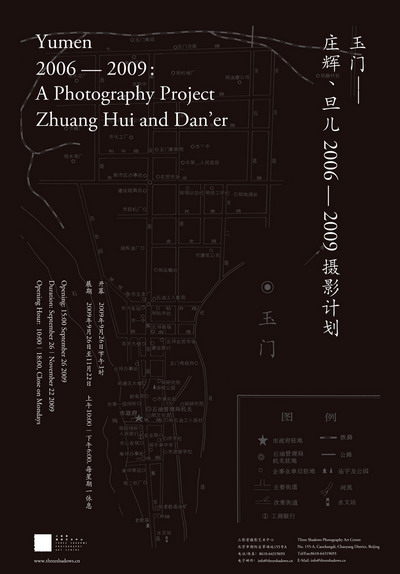
展览名称:玉门——庄辉、旦儿 2006-2009摄影计划
展览地点:三影堂摄影艺术中心 中国北京草场地155号A
开幕时间:2009年9月26日下午4点
展览时间:2009年9月26日——11月22日,10:00-18:00(法定假日及每周一休息)
人类的历史也是资源利用的历史。对煤炭、石油、天然气的开采和利用曾经强劲地推动了工业文明的产生和发展。这些化石燃料是亿万年前由生物遗体经过地质作用形成的,是不可再生的能源。对化石燃料的开发利用意味着动用了储存在地下的在人类历史之前来自太阳的能量,从而满足人们试图超越自然条件的限制而加速发展的企图。工业文明的发展和科技的革新给人类的生活带来了巨大的进步,然而对化石燃料不加节制的利用也带来了生态平衡的破坏、环境污染、气候改变等不利于人类生存的问题。同时对化石能源的严重依赖使人类在这一资源面临枯竭的时候面临着严重的困境。人们开始思考如何调整并改变人类利用能源的方式,并且对人类与自然的关系以及人类文明的进程进行反思,探讨可持续的和更健康的发展模式,进而在日常生活的层面进行力所能及的努力。这不仅是一个科技和经济的命题,也是今天的思想文化领域着力关注的方向。
作为中国的石油产业诞生的地方,玉门油田在三十年代曾经为艰难困苦中的中国贡献了它宝贵的资源。然而在资源耗尽以后,诸多社会问题浮出水面。体制、社会阶层、民族、价值观等各方面的因素纠缠在一起,使被遗弃的玉门表现了错综复杂的社会景观。政府意志、地缘经济、底层民生、自然生态等种种矛盾产生了尖锐的对立和冲突。涸泽而渔的生产方式,体制转变留下的阴影,残垣断壁的街道和人去楼空的城市,入夜后的无政府状态,使玉门呈现了一个极为特殊的西部荒野与蜕化的工业的合成机体。然而人们仍然生活在这座高海拔的城市中,普通百姓仍然延续着日常生活的平凡,延续着他们的简单需要和大大小小的希望和梦想。
作为重要的中国当代艺术家之一的庄辉就出生在距油田70余公里的玉门镇。与众多当代艺术家不同,庄辉的青少年时代不是从中学到大学,而是从十五岁就开始在重型机械厂作为产业工人度过的。出于对艺术的喜爱,庄辉走出了一条独特的艺术道路。底层的社会经验和他对艺术家身份的独特认识,使他的作品直接地切入了社会现实,并且总是将目光专注于普通人,特别是底层劳动阶层。从1992年的作品“为人民服务”、1995年的摄影作品“一个和三十个”(作者分别与三十个农民、工人、艺术家、儿童合影)直到1996年开始的与不同的职业团体(工人、农民、士兵、学生、医护人员等)多达几百人的合影,使庄辉成为了一位广受国际关注的重要中国当代艺术家。2000年前后,庄辉创作了几组大型的装置作品,同样将社会问题和普通人的生存状态作为作品的侧重点。旦儿是一位出生于陕北的女艺术家,2006年开始同庄辉合作创作。他们一同实施了五十幅社会新闻图片的大幅油画作品的计划,关注了网络上流行的底层社会新闻这样构成巨变中的中国社会然而常常被主流的话语所遮蔽的声音。
2006年庄辉和旦儿开始对玉门计划进行酝酿和构思,他们作了大量的实地调查,拍摄了大量的图片和录像素材。从对当地的历史、人文、社会生活的变迁等各方面的关注发展到对石油开采的历史、时代转换中东西方的冲突和互动在石油方面的表现,以及对人类生存状况的思考和反省。他们的努力虽然不是从严格意义上的社会学研究的角度,但是他们的第一手材料和切身感受是非常宝贵的。从发现、接触、调研,他们逐渐形成了一个完整的艺术计划,将艺术作品所具有的能力凝聚在一个为期一年的照相馆计划上面。这一计划并没有单纯而直接地反映石油枯竭所带来的超常景观和严重的社会问题,而是将目光投向了生活在当地的一个个的普通人。庄辉和旦儿在当地开了一家货真价实的照相馆,提供普通照相馆的服务,为当地人拍摄证件照、艺术照、合影等等。在化妆、服装道具、布景、灯光等方面遵循了现实当中的审美取向。对这些普通人的注视使人感觉到在这些普通人身上发生的事情同样可以发生在我们每一个人身上,他们日常面对的问题与你我所面对的没有什么本质的不同。这是一个生存中的原点状态——急功近利地对眼前利益的追逐和对保存人类生存环境的美好愿望都是从这一原点出发的。
庄辉和旦儿将照相馆及其产生的结果移植到了艺术空间的语境中,现实生活中一年的时间被压缩到了一个具体的空间,艺术作品与具有实用功能的影像融为了一体。在三影堂摄影艺术中心这样一个具有专业指向性的空间中,庄辉和旦儿的计划触及到了摄影艺术的外延和内涵方面的诸多问题。与影像有关的环境布置、具有实用功能的影像产品、背景和条件的铺陈和介绍等等有机地构成了这一作品。摄影艺术与日常应用的照片产生了互涉,促使人们重新审视日常照片以及大众审美所具有的更丰富的意义,同时摄影艺术也随之得以拓展和丰富。
现实总是极端地强大。处于理想范畴的艺术如果能对现实产生影响,那么起到作用的是艺术家的态度。
Yumen: A 2006-2009 Photography Project
by Zhuang Hui and Dan’er
Location:Three Shadows Photography Art Centre
No. 155A Caochangdi, Beijing, China
Opening:September 26th, 2009 4pm
Exhibition Dates:September 26th to November 22nd, 2009, 10am to 6pm(closed on Mondays and national holidays)
The history of humanity is also the history of the use of natural resources. The drilling and exploitation of coal, oil, and natural gas drove the increase in production capabilities and the development of industrialized civilization. Fossil fuels are the result of the decomposition of animal remains over hundreds of millions of years. As such, they are natural resources that cannot be replenished. Their drilling and exploitation are equivalent to using deposits of the sun’s energy stored underground since before the birth of humanity. The utilization of these resources has given Man the capacity to surpass the limits imposed by nature and increase the speed of civilization’s development. While the development and technical innovations of industrial civilization have advanced humanity a great deal, the unrestrained use of fossil fuels has also broken the ecological balance, causing environmental pollution, climate change, and many other problems that can affect humanity’s very existence. Humanity’s complete dependence on fossil fuels creates a grave dilemma since this natural resource will eventually be exhausted. Mankind is now beginning to think about ways to adjust the use of natural resources as well as reconsider the relationship between men, nature, and the advancement of civilization. Nations are increasingly trying to incorporate sustainability and healthier development models into everyday life. Today, this is no longer only a technological and economic question – it is also an avenue for focused though in the realm of arts and culture.
In the 1930’s the Yumen oil fields contributed their precious resources to a barren China. Once they were exhausted, however, many social problems came to light. Serious concerns within institutions, social classes, nationalities, and values became entangled, turning the abandoned city of Yumen into a stage for many complex social crises. Differences between governmental decisions, regional economics, ordinary people’s lives, and natural ecology led to sharp conflicts. The self-destructive oil production methods, the shadows of institutional changes, the deserted streets and buildings, and the uncontrollable situation in the city after sun-down have made Yumen into an urban synthesis of the “Wild West” and industrial degeneration. Yet, today still, people continue to live in this high-altitude metropolis, carrying out their everyday lives and eking out an existence while pursuing their hopes and dreams.
Zhuang Hui, an important Chinese contemporary artist, was born in the city of Yumen, 70 kilometers away from the oil fields. Unlike many contemporary artists, he did not follow the usual path, attending high school then university. Rather, he started to work as an operator at a heavy machinery factory at the age of 15. He became an artist through an unusual route, prompted by his love for art. His experience as a menial worker and his unique perspective on an artist’s identity infuse his works with a direct connection to social realities. He always turns his gaze toward the ordinary person, especially the working man.
Zhang Hui garnered international attention with his 1992 work “Serve the People”, his 1995 photography work “One and Thirty” (self portraits with 30 farmers, workers, artists, and children), and his 1996 group photographs which show more than 100 members of the same profession (workers, farmers, soldiers, students, doctors and nurses) in one single frame. In 2000, he created several large installation pieces that emphasized both social problems and ordinary people’s existence.
Dan’er, a female artist born in Shanbei, started to work with Zhuang Hui in 2006. Together, they created 50 large oil paintings about popular online news stories that reflected the changes in Chinese contemporary society, and which were consistently blocked by the mainstream media.
In 2006, Zhuang Hui and Dan’er began planning the Yumen project. They surveyed the area and recorded their observations in photographs and videos. As they explored, their focus shifted from changes in the area’s history, inhabitants, and society to the history of oil drilling, the conflicts and interactions between East and West based on oil issues, and finally to reflections on humanity’s existence. Though their work is not strictly based on sociological research methodology, their first-hand accounts and impressions remain very valuable.
This research gradually gave shape to the concept for an art project: a photography studio in Yumen that would be in existence for one year. While this does not directly reflect the grave social problems brought on by the depletion of oil supplies, it does highlight the life of ordinary individuals living in the area. Zhuang Hui and Dan’er opened a real photography studio in Yumen, providing all the services to be found in any other studio of the kind, such as identification photos, art photographs and group portraits. Makeup, clothing, props, set, and lighting were carefully chosen in order to reflect the popular styles and aesthetic preferences in the area.
The gaze of these people makes us see that what happened in their lives can happen in anyone’s life – that the problems they face are no different from those we all face. The desire to both advance in life and preserve the environment for mankind comes from one shared point of origin.
Zhuang Hui and Dan’er transplanted the photography studio and its results into the context of the art space. One year of real life was compressed into one defined area; artwork and functional images fused into one.
At the Three Shadows Photography Art Centre, Zhuang Hui and Dan’er’s project addresses the many explicit and implied connotations of photography art. The presentation of background information works with the installation of these functional photographs to organically create this art piece. Art and function interact, allowing people to look differently at simple photographs and comprehend the significance of people’s aesthetic choices. Thus, the meaning of photography art expands and becomes richer.
Reality is formidable. It can only be influenced by an artist’s perspective and sensibility.
![[北京]时代美术馆“楼上的青年: 2010青年批评家提名展”](attachment/100601/48ac4fdc6c.jpg)